
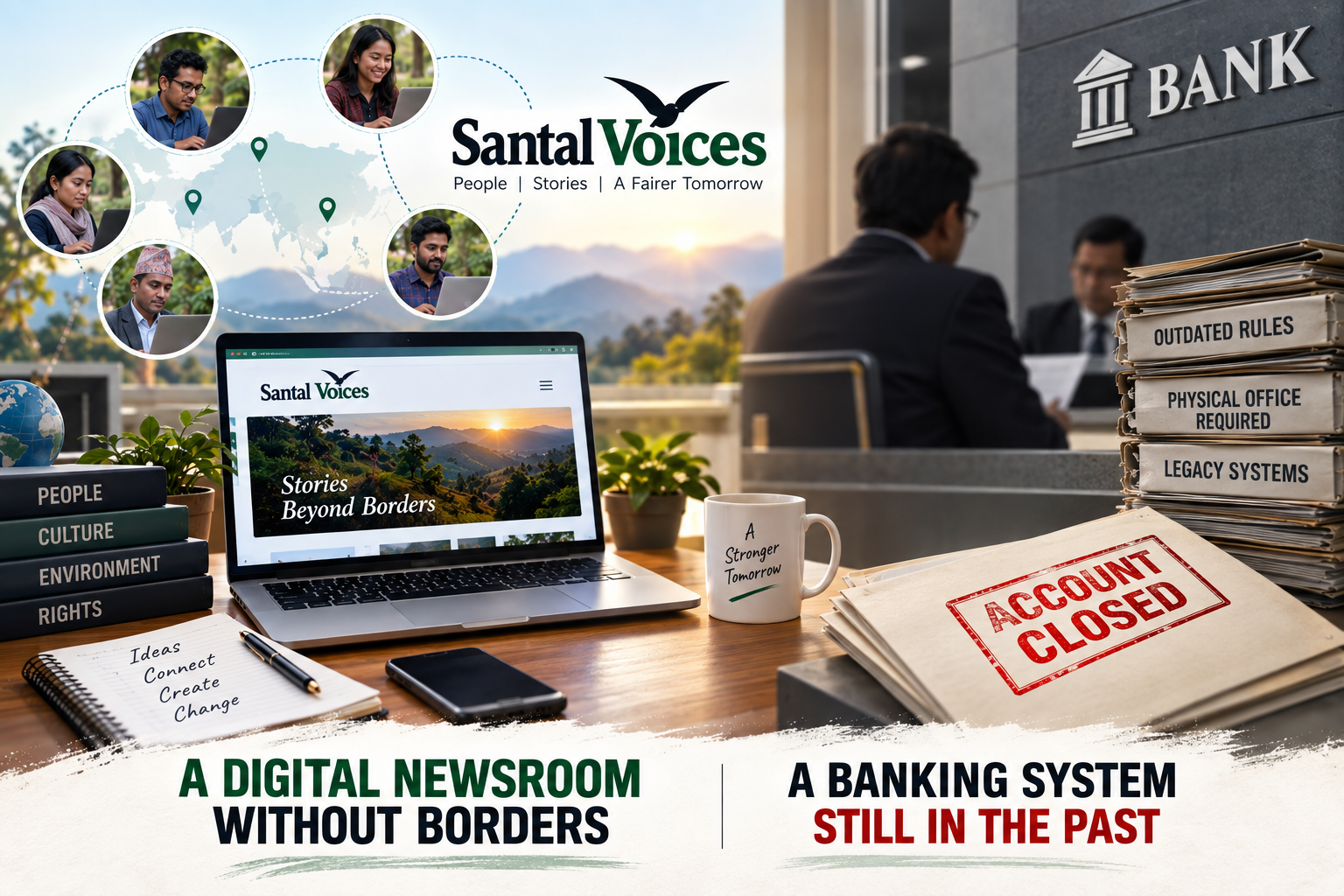
The experience of Santal Voices raises a larger question: Are our institutional procedures keeping pace with the way the new generation works?
The world of work has changed dramatically. Businesses, media platforms and creative initiatives are increasingly being built and operated virtually, with people collaborating across cities, states and even national borders. Yet, some of our institutional procedures still appear to be designed for an era when every organisation was expected to have a signboard, an office room, desks, computers and employees working under one roof.
Our recent experience at Santal Voices has made us reflect on this gap.
Santal Voices is a web-based media and community platform operated through the collective efforts of contributors from different parts of India, Nepal and Bangladesh. Within India, our contributors are spread across Odisha, West Bengal, Jharkhand, Assam and other places. They write, edit, communicate and contribute digitally. There is no requirement for everyone associated with the platform to sit together in a conventional newsroom.
And we have never claimed otherwise.
As Santal Voices gradually grew, we felt the need to have a formal banking channel through which support from readers and well-wishers could be received and expenses related to running the platform could be managed transparently. Accordingly, a Current Account was opened with a nationalised bank in the name of Santal Voices, under the proprietorship of our Editor.
For official communication and correspondence, the residence of our Publisher was declared as the office and correspondence address. This was not an attempt to hide the nature of our operation. On the contrary, it reflected exactly how Santal Voices functions—as a digital platform whose work does not depend upon a conventional physical office.
A web portal does not necessarily need a brick-and-mortar newsroom.
Today, an editor can review an article from Odisha, a contributor can send a report from Jharkhand, another can participate from West Bengal, while contributors from Nepal or Bangladesh can collaborate through the internet. Meetings can happen virtually, documents can be edited online, photographs and videos can be transmitted within seconds, and an entire publication can be managed from laptops and mobile phones.
That is no longer unusual. That is simply how the digital world works.
However, our Current Account was subsequently closed, with concerns being raised regarding proper business details. When we contacted the concerned bank officials, we were informed that the central processing mechanism handling such accounts expected physical indicators of a conventional media establishment—a newsroom, multiple computers, editors and related infrastructure.
The local officials understood our explanation and the nature of our digital operation. We appreciate their effort and understanding. Yet, they too appeared constrained by procedures and requirements beyond their immediate control.
This experience therefore should not be viewed merely as a dispute between Santal Voices and a bank. Nor do we wish to blame individual officials who are required to work within the rules and systems available to them.
It raises a much larger question.
Have our institutional procedures evolved sufficiently to recognise the new forms of enterprise emerging in the digital age?
We are living in the era of Generation Z and Generation Alpha. A young person today can develop software from a bedroom, operate an online publication from a laptop, provide professional services to clients thousands of kilometres away, or collaborate with a team whose members may never have physically met one another.
In such an environment, the existence of a business cannot always be measured by the number of chairs, computers or rooms visible at a particular address.
Certainly, banks have legitimate responsibilities. Customer identification, verification of business activities, prevention of fraud, compliance with KYC requirements and financial transparency are essential safeguards and cannot be compromised. But compliance mechanisms should also be capable of distinguishing between the absence of a genuine business and the genuine existence of a digital-first business without a conventional office.
A web portal can demonstrate its existence through its website, domain records, publishing history, editorial activity, invoices, registrations, digital infrastructure, correspondence, contributor network and other verifiable evidence. These may sometimes provide a more accurate picture of a digital enterprise than simply counting computers inside a room.
Technology has changed not only how we communicate but also what an office means.
For Santal Voices, our newsroom is not confined within four walls. It exists wherever our contributors research, write, edit, translate and publish. It stretches across Odisha, West Bengal, Jharkhand and Assam, and beyond India’s borders to Nepal and Bangladesh.
Our office, in that sense, is virtual—but our work is real.
The experience has taught us something important. Digital India cannot be built only by providing digital services to customers. The procedures behind those services must also evolve to understand digital businesses and new models of work.
The banking sector has transformed enormously through internet banking, mobile banking, UPI and paperless services. Perhaps the next stage of that transformation is equally important: modernising institutional understanding of what constitutes a workplace, an enterprise and a legitimate digital business.
The new generation is no longer waiting for an office before beginning its work.
Our systems should be ready to recognise that reality.