
The twenty-first century has witnessed remarkable scientific achievements, unprecedented technological growth, and increasing global interconnectedness. Yet these developments have been accompanied by serious challenges. Climate change threatens ecosystems across the world. Social isolation has become a growing concern despite greater digital connectivity. Cultural homogenization risks erasing local traditions and indigenous knowledge systems. Economic growth has often been accompanied by environmental degradation and widening inequalities. These realities have led many scholars to reconsider fundamental questions concerning human existence and the meaning of progress. What constitutes a truly good life? Can material advancement alone satisfy human aspirations? What responsibilities do individuals and societies have toward nature and future generations? In seeking answers to such questions, indigenous wisdom traditions offer valuable insights that complement contemporary philosophical discourse.
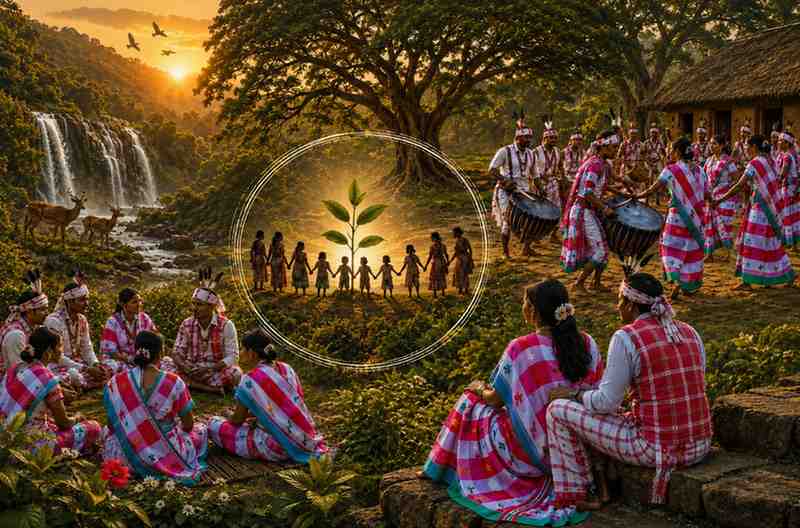
Among these traditions, the Santali worldview presents a particularly rich source of reflection. The Santals have preserved a vibrant cultural heritage through oral traditions, communal institutions, festivals, music, dance, and close interaction with the natural environment. Although Santali thought has not historically been expressed through extensive written philosophical treatises, it nevertheless embodies a coherent vision of reality and human existence. This vision emerges through practice rather than theory, through lived experience rather than abstract speculation. It offers a philosophy rooted in relationships, reciprocity, and harmony.
One of the defining characteristics of modern thought has been the tendency to separate humanity from nature. Since the rise of industrial modernity, nature has increasingly been understood as an object to be controlled, measured, and utilised for human purposes. This perspective has undoubtedly contributed to scientific advancement and economic development. However, it has also encouraged forms of exploitation that have damaged ecosystems and weakened humanity’s sense of belonging within the natural world. The Santali worldview presents a striking contrast to this orientation. Nature is not merely a collection of resources but a living reality with which human beings maintain an ongoing relationship. Forests, rivers, mountains, animals, and agricultural lands are woven into the fabric of social and cultural life.
From a philosophical perspective, this relationship reflects a different understanding of existence itself. Human beings are not external observers standing apart from nature. They are participants in a larger ecological order. Their well-being depends upon the health of the environment, and their actions have consequences that extend beyond immediate human interests. Such a perspective encourages humility. It reminds individuals that they are not the sole centres of value in the universe but members of a broader community of life. This understanding is increasingly relevant in an age when ecological crises reveal the limitations of anthropocentric worldviews.
The notion of interconnectedness that characterises Santali thought extends beyond the relationship between humanity and nature. It also shapes social life. Human beings are understood not as isolated individuals but as members of families, communities, and cultural traditions. Identity is formed through participation in social relationships. A person’s achievements acquire significance within a network of shared meanings and responsibilities. This understanding contrasts sharply with forms of radical individualism that view personal autonomy as the highest value.
The modern ideal of the self-made individual often obscures the extent to which every human life depends upon others. Language, culture, education, emotional support, and social opportunities are all products of collective effort. The Santali emphasis on community brings this reality into focus. Community is not merely a practical arrangement for mutual benefit; it is an essential condition for human flourishing. Individuals thrive when they are embedded within supportive social relationships characterised by trust, cooperation, and shared purpose.
This emphasis on community carries important ethical implications. Ethical life is not conceived merely as obedience to abstract rules but as the cultivation of harmonious relationships. Responsibilities arise naturally from participation in a shared world. Individuals are expected to contribute to the well-being of others because they themselves benefit from communal support. Such an ethical framework fosters reciprocity rather than competition and cooperation rather than domination.
The principle of reciprocity occupies a central place within many indigenous traditions, and Santali culture is no exception. Reciprocity recognises that life itself is sustained through mutual exchange. Human beings receive benefits from nature, from society, and from previous generations. In turn, they bear responsibilities toward others. This ethical vision challenges the notion that individuals can pursue their interests independently of broader social and ecological concerns. It suggests that genuine freedom is inseparable from responsibility.
Philosophers throughout history have debated the relationship between freedom and obligation. Some have emphasised individual autonomy, while others have highlighted social duties. The Santali perspective offers a balanced approach. Freedom is valuable, but it flourishes within relationships rather than outside them. Individuals become truly free not when they escape all obligations but when they participate meaningfully in a community that enables personal growth and collective well-being.
Another significant aspect of Santali wisdom concerns the role of memory and tradition in human life. Modern societies often associate progress with novelty and innovation. While innovation undoubtedly contributes to human advancement, an exclusive focus on the future can lead to the neglect of cultural memory. Traditions preserve accumulated wisdom, values, and experiences that connect generations across time. They provide continuity and orientation in a rapidly changing world.
For the Santali community, traditions are not merely relics of the past. They are living sources of identity and meaning. Through songs, stories, rituals, and festivals, individuals encounter the experiences of previous generations and develop a sense of belonging within a larger historical narrative. Philosophically, this reflects an understanding of human beings as temporal creatures whose identities are shaped by both memory and aspiration. We inherit a world created by those who came before us, and we bear responsibility for the world we leave behind.
The importance of cultural memory becomes particularly evident in contemporary discussions concerning globalisation. Globalisation has facilitated unprecedented exchanges of knowledge, goods, and ideas. Yet it has also contributed to cultural homogenization. Local traditions frequently struggle to survive in the face of dominant cultural influences. The preservation of Santali culture, therefore, carries significance beyond the community itself. It contributes to the preservation of humanity’s cultural diversity and demonstrates that multiple ways of understanding the world can coexist and enrich one another.
Santali wisdom also offers valuable insights into the philosophical question of happiness. Throughout history, philosophers have proposed different conceptions of the good life. Some have emphasised pleasure, others virtue, knowledge, spiritual realisation, or social harmony. Modern consumer culture often equates happiness with material prosperity and consumption. However, increasing evidence suggests that material wealth alone cannot guarantee fulfilment. Individuals may possess abundant resources yet experience loneliness, anxiety, and dissatisfaction.
The Santali understanding of well-being points toward a more holistic conception of happiness. Fulfilment emerges through meaningful relationships, participation in communal life, cultural expression, productive work, and harmony with nature. Material needs are important, but they do not exhaust the requirements of a good life. Human beings seek belonging, purpose, recognition, and connection. These dimensions of existence cannot be purchased or measured solely in economic terms.
This perspective resonates with philosophical traditions across cultures. Aristotle’s concept of Eudaemonia emphasised the development of human capacities within a community. Classical Indian philosophies frequently linked well-being to harmony, self-knowledge, and ethical conduct. The Santali worldview contributes to these broader discussions by demonstrating how flourishing can be realised through everyday practices of cooperation, gratitude, and ecological awareness.
The significance of gratitude deserves particular attention. Modern societies often encourage endless striving formore wealth, more status, more consumption, and more achievement. While ambition can motivate progress, it can also generate perpetual dissatisfaction. Gratitude offers an alternative orientation toward life. It encourages recognition of what has already been received from nature, family, community, and culture. Such recognition fosters contentment without discouraging growth. It enables individuals to pursue improvement while remaining aware of their dependence upon others.
The philosophical importance of gratitude lies in its capacity to transform human relationships. Individuals who acknowledge their dependence upon others are less likely to view themselves as entirely self-sufficient. They become more open to cooperation, compassion, and mutual respect. In this way, gratitude contributes not only to personal well-being but also to social harmony.
The contemporary relevance of Santali wisdom becomes increasingly apparent when viewed against the backdrop of global challenges. Environmental degradation reflects a failure to recognise humanity’s dependence upon nature. Social fragmentation reflects a weakening of communal bonds. Cultural erosion reflects a neglect of historical memory and identity. Consumerism reflects confusion regarding the nature of happiness. In each of these areas, the philosophical insights embedded within Santali life offer valuable correctives.
This does not imply that indigenous traditions provide ready-made solutions to every contemporary problem. Nor does it require idealising any particular culture. Rather, it involves recognising that different societies preserve different forms of wisdom. Genuine philosophical inquiry requires openness to learning from diverse sources. Santali thought contributes to this dialogue by emphasising interconnectedness, reciprocity, ecological responsibility, cultural continuity, and communal flourishing.
Ultimately, the greatest philosophical contribution of Santali wisdom may be its vision of relational existence. Human beings are not isolated entities pursuing private interests within a meaningless universe. They are participants in a network of relationships that includes nature, community, culture, history, and future generations. Meaning emerges through these relationships. Flourishing arises through their cultivation. Ethical responsibility grows from awareness of interdependence.
In a world increasingly characterised by division, ecological crisis, and uncertainty, this vision possesses profound significance. It reminds us that human flourishing cannot be achieved through domination, isolation, or unlimited consumption. Rather, it requires harmony, reciprocity, responsibility, and respect. The Santali worldview, therefore, represents not only a valuable cultural heritage but also an enduring philosophical resource for humanity’s ongoing search for wisdom and the good life.