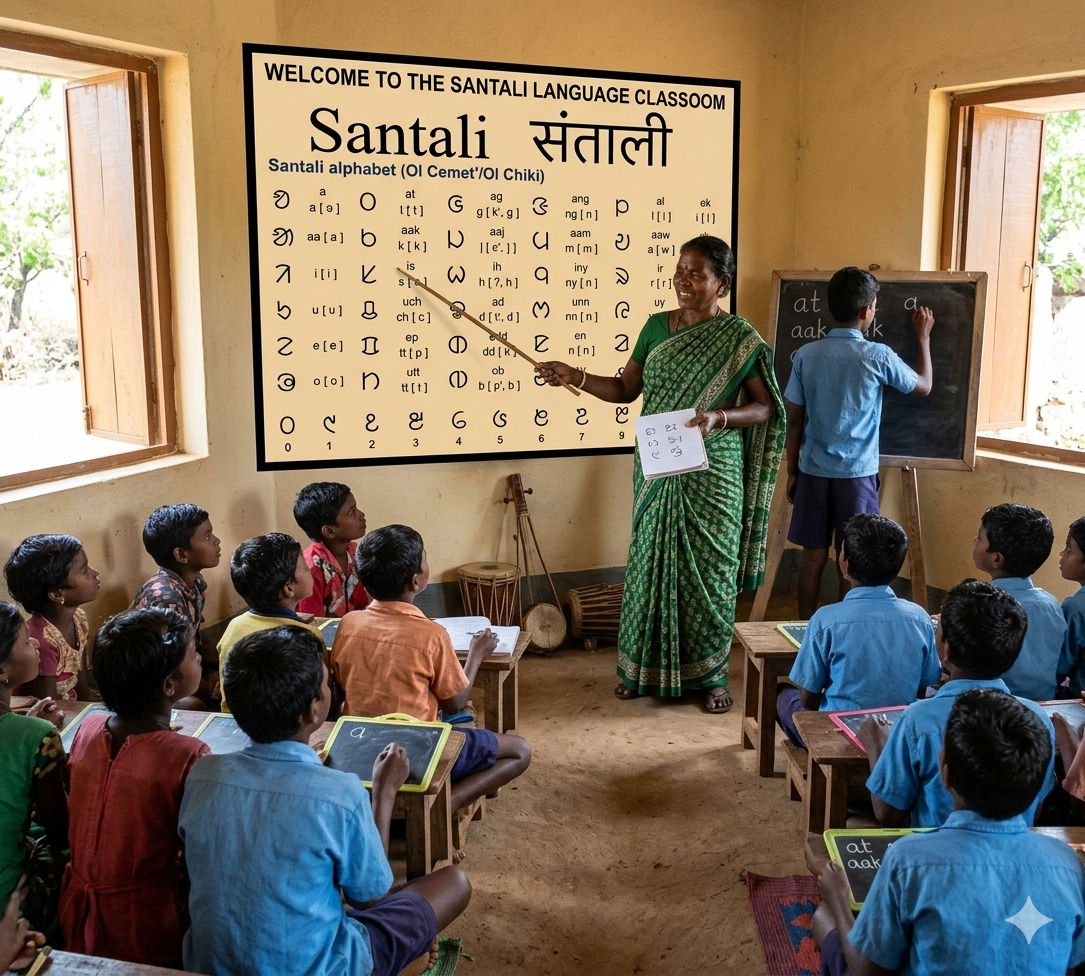

The Santal tribe is the third-largest tribal community in India. Santals are known for their peaceful, simple, courteous, and humble nature. However, whenever their motherland, land rights, or dignity are threatened, they never hesitate to rise in resistance.
A remarkable example of this spirit can be seen during the British colonial period. After the British established the East India Company in India, they gradually annexed various princely states and regions and imposed arbitrary rule. They forcefully occupied the lands of the Santals and levied excessive taxes and rents on them. These oppressive policies eventually led to a fierce uprising between the British administration and the Santal people.
The struggle waged by the Santal community against British rule in pursuit of freedom and justice remains one of the most memorable chapters in India’s history. Their courage, sacrifice, and determination continue to inspire generations and hold a significant place in the history of India’s freedom movement.
Opposing British colonial rule, the Santal people organized a historic mass gathering on 30 June 1855. This day is regarded as one of the most significant days in the history of the tribal communities and is commemorated as Hul Diwas. The uprising itself is remembered in Indian history as the Santal Rebellion or Santal Hul.
The rebellion was launched by the Santal people living in the Santhal Pargana and the Rajmahal Hills, situated along the present-day border of West Bengal and Jharkhand. At that time, Lord Dalhousie was the Governor-General of India.
The British had encouraged Santals from regions such as Dhalbhum, Manbhum, Hazaribagh, and Medinipur to settle in the area by promising land and economic opportunities. However, these promises were not fulfilled. Instead, landlords exploited them as bonded labourers, while moneylenders trapped them in debt through exorbitant interest rates and forcibly seized their lands. Santal women were also repeatedly subjected to sexual violence. Whenever anyone raised their voice against these injustices, the landlords, with the support of hired goons and the British police, brutally suppressed them.
During the same period, the British began constructing railway lines for the first time in the region. Large areas of fertile tribal farmland were acquired without fair compensation, creating widespread resentment among the Santals. Even when they approached the courts seeking justice, they were met with discrimination and injustice instead of relief.
These circumstances united not only the Santals but also many poor non-tribal communities in the movement against British rule. The people unanimously chose two of the four Murmu brothers, Sidhu Murmu and Kanhu Murmu, as their leaders.
On 30 June 1855, they initially resolved to undertake a peaceful march to Calcutta (now Kolkata) to submit their grievances directly to the British Governor-General, believing that their sufferings might be addressed. A massive tribal assembly was held at Bhognadih, from where the march began.
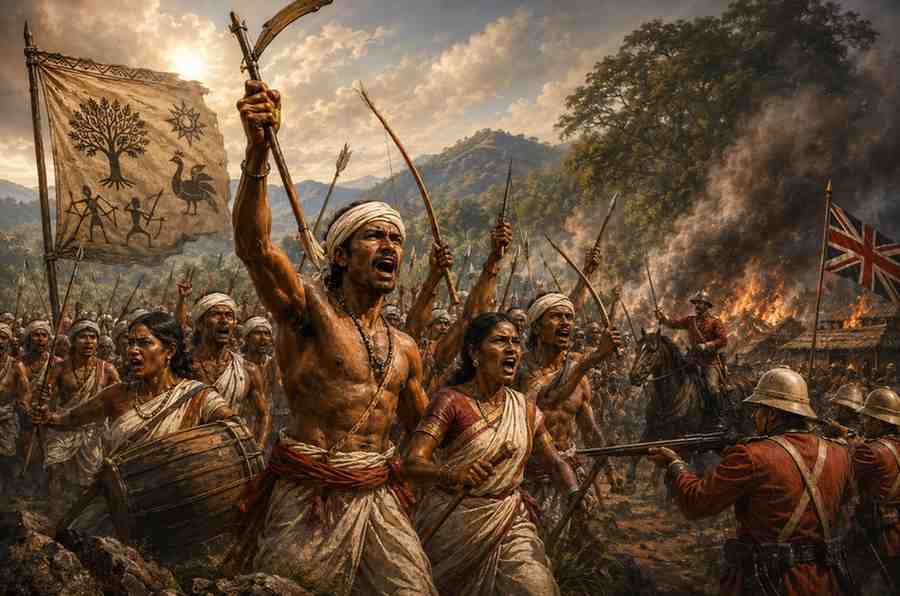
However, British authorities blocked the procession by deploying additional police forces and arresting key leaders. It soon became clear to Sidhu, Kanhu, and their followers that the British had no intention of allowing a peaceful appeal. Realizing that petitions would not bring justice, they concluded that armed resistance was the only remaining option. The rebels took up their traditional weapons and attacked several oppressive landlords and moneylenders.
Initially, the British government sent only a small military force to suppress the rebellion, but it failed, encouraging the rebels even further. As law and order deteriorated, the British launched a large-scale military operation. Reinforcements were sent to the affected areas with assistance from local landlords and the Nawab of Murshidabad. Elephants supplied by the Nawab were reportedly used to demolish Santal houses.
The East India Company announced a reward of 10,000 rupees for the capture of Sidhu and Kanhu Murmu. A series of fierce battles followed, resulting in heavy casualties among the Santal fighters. Armed mainly with traditional weapons, they could not match the Company’s modern firearms. The British deployed several military units, including the 7th Native Infantry Regiment and the 40th Native Infantry Regiment, to crush the uprising.
From July 1855 to January 1856, major battles were fought in places such as Kahalgaon, Suri, Raghunathpur, and Munkatora. Eventually, after Sidhu and Kanhu were killed or captured, the Company succeeded in suppressing the rebellion.
More than 15,000 people are believed to have lost their lives, and hundreds of villages were destroyed during the conflict. At its height, the movement united nearly 60,000 Santals, organized into approximately 1,500 to 2,000 groups. Besides the tribal communities, several non-tribal groups, including cattle herders, blacksmiths, and other local communities, supported the movement by supplying information and weapons.
The rebellion lasted for nearly eight months, from 30 June 1855 to February 1856. During this period, the woman leader Phulo Murmu was reportedly subjected to brutal sexual violence and killed, after which her mutilated body was allegedly thrown beside a railway line. Sidhu and Kanhu’s brothers, Chand Murmu and Bhairab Murmu, were also brutally killed.
The British government continued to offer a reward of 10,000 rupees for the capture of Sidhu and Kanhu. In the first week of February 1856, Sidhu Murmu was killed by British gunfire. About a week later, Kanhu Murmu was captured alive. With the death and capture of its principal leaders, the British finally succeeded in suppressing the great Santal Hul (Santal Rebellion).
Today, the Santal Hul is remembered as one of the earliest and most significant organized tribal uprisings against British colonial rule in India, symbolizing the Santal people’s enduring struggle for justice, dignity, and freedom.