
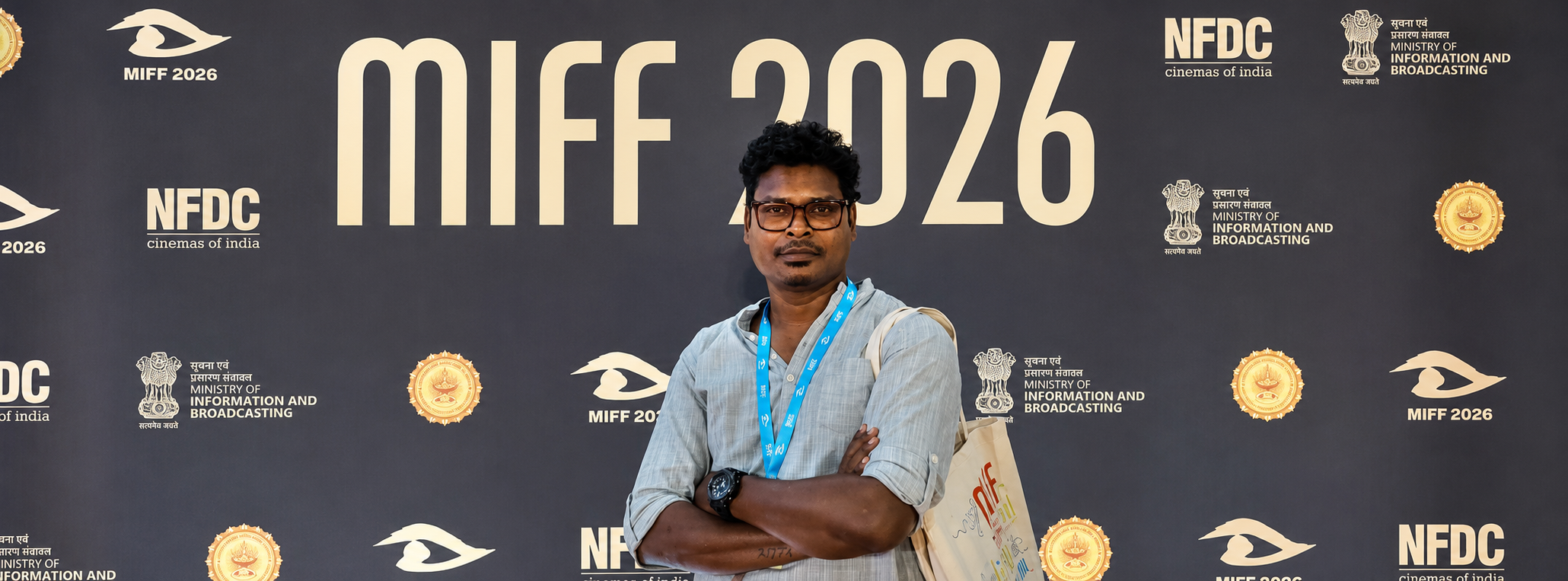
Santali filmmaker Deepak Kumar Beshra from Odisha represented India’s growing indigenous film movement at the 19th Mumbai International Film Festival (MIFF) 2026, where he was invited by the National Film Development Corporation (NFDC) as a panelist for the round-table discussion, “Many Forms, One Vision: Celebrating Diversity in Film Festivals.” Speaking before an audience of festival directors, filmmakers and cinema professionals from India and abroad, Beshra highlighted the opportunities and challenges facing Santali and indigenous cinema.
Following the conclusion of MIFF 2026, the Santal Voices editorial team held an exclusive conversation with Deepak Kumar Beshra to understand his experience at the festival, the key discussions that took place, and his vision for the future of Santali and indigenous cinema. During the interview, he reflected on his remarkable journey—from a curious child fascinated by film projectors to becoming one of the voices representing indigenous cinema on one of India’s most prestigious international film platforms.
A Proud Moment for Indigenous Cinema
Describing his participation as one of the most memorable moments of his career, Deepak said that sharing the stage with internationally renowned festival directors, filmmakers, and cinema experts was both humbling and inspiring.
The panel featured distinguished personalities including Anand Varadaraj, Premendra Mazumdar, Nilotpal Majumdar, Patricia Sánchez Mora, Prakash Magdum and Savitri Hari.
“It was a proud and unforgettable experience to represent the tribal filmmaking community on such a prestigious platform. As someone from the Santali community, I felt honoured to speak about tribal cinema before such a distinguished audience,” Deepak told Santal Voices.
Raising the Voice of Santali Cinema
During the panel discussion, Deepak highlighted the realities of the Santali film industry. He spoke candidly about the limited budgets, lack of technical infrastructure, inadequate skill development opportunities, difficulties in film distribution, and the challenges faced by indigenous filmmakers in reaching wider audiences.
At the same time, he emphasized the immense untapped potential of tribal cinema and the importance of creating stronger institutional support for indigenous storytellers. He stressed that indigenous communities must tell their own stories in their own voices, because when others narrate them, the authenticity of lived experiences is often lost.
Lessons from Film Festival Leaders
One of the most valuable aspects of MIFF, according to Deepak, was learning from experienced festival directors from India and abroad.
Although the discussion focused on film festivals rather than filmmaking itself, he said he gained important insights into how international festivals are funded, managed, attract sponsors, and receive submissions from filmmakers across the world.
These conversations, he believes, will help strengthen the future of the Baripada Indigenous Short Film Festival (BISFF) and create better opportunities for indigenous filmmakers.
BISFF: A Growing Indigenous Platform
During the discussion, Deepak also shared the remarkable journey of the Baripada Indigenous Short Film Festival (BISFF).
He explained that when the festival began in 2017, most submissions came from tribal filmmakers themselves. Today, however, the festival attracts a growing number of non-tribal filmmakers who are producing documentaries and short films on indigenous communities. He described this as an encouraging sign that tribal stories are gaining wider recognition across India.
He also spoke about the continuous efforts of the Santali Art and Film Development Foundation (SAFDF) in organizing filmmaking workshops, acting and scriptwriting programmes, and creating learning opportunities for aspiring filmmakers from grassroots communities.
A Journey Born from Curiosity and Determination
In his conversation with Santal Voices, Deepak reflected on his childhood in Rourkela, where his fascination with cinema began long before he entered filmmaking.
As a young boy, he was captivated not only by films but also by the projector itself. During open-air film screenings held during Durga Puja, he often spent more time observing the projector and the beam of light than watching the movie. That childhood curiosity eventually became the foundation of his filmmaking journey.
Deepak also revealed a deeply personal chapter of his life that transformed his career.
While working in Hyderabad, he was diagnosed in 2011 with Acute Lymphoblastic Leukemia (ALL), a rare form of blood cancer. During treatment, he realised that life was uncertain and decided to pursue his lifelong passion for cinema. Soon after recovering, he created his first Santali music videos and later directed his first feature film.
Looking back, he says the illness changed the direction of his life forever.
The Need for Better Skills
While appreciating the growing enthusiasm among young Santali filmmakers, Deepak believes the industry must now focus on improving filmmaking skills rather than merely increasing the number of productions.
He urged young filmmakers to participate in workshops, short-term training programmes, and continuous learning, saying that stronger technical knowledge will naturally lead to better films and greater recognition for Santali cinema.
Building Institutions for Future Generations
Reflecting on the establishment of the Santali Art and Film Development Foundation (SAFDF) in 2016, Deepak explained that the organisation was born out of disappointment after facing a lack of institutional support for screening one of his films.
Rather than waiting for others, he chose to build a platform of his own.
Today, SAFDF has grown into one of the leading indigenous film organisations in eastern India, organising the Baripada National Indigenous Short Film Festival (BISFF), filmmaking workshops with educational institutions, acting and scriptwriting training, community screenings, and the newly established Tribal Theatre Centre.
For Deepak, every initiative represents a small but meaningful contribution towards strengthening indigenous cinema.
Looking Ahead
Despite receiving national recognition, Deepak remains realistic about the current state of Santali cinema.
“We still have a long journey ahead before making a significant impact on Indian and world cinema,” he said.
Nevertheless, his commitment remains unwavering.
“Filmmaking has given me an identity. If I can contribute even a little towards making Santali cinema better, I will consider my life meaningful. This is something I want to continue for the rest of my life.”
A Milestone for the Indigenous Film Movement
Deepak Kumar Beshra’s participation at MIFF 2026 was more than an individual achievement. It represented the growing recognition of indigenous storytelling within India’s mainstream film ecosystem.
Through his voice, the concerns, aspirations, and creative potential of the Santali filmmaking community reached one of the country’s most respected international film platforms.
As indigenous cinema continues to evolve, leaders like Deepak Kumar Beshra are not only creating films but also building institutions, mentoring young talent, and ensuring that tribal stories are narrated by the communities to whom they truly belong.